WRECK VALLEY · 0.61.3 · IMPLEMENTATION & VERIFICATION
See the decision.
Watch the car act.
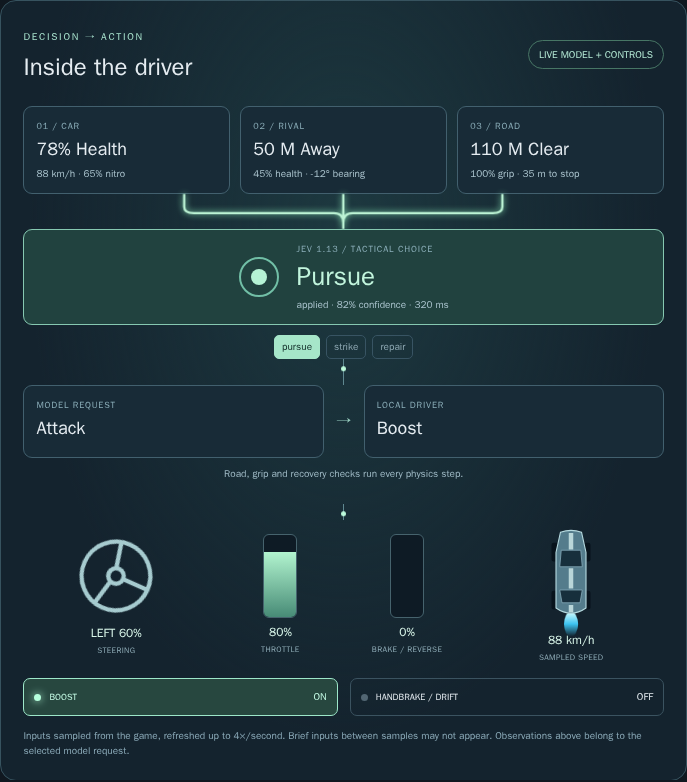
Sessions now lead the control room. A diagram on the right connects Jev’s observations and choices to actual steering, pedal, nitro and drift inputs. Pursuit also stays focused on the rival, with locally timed attack maneuvers.
A visual control room
This is a recorded interface integration test with a deterministic model stub and real server, ledger, sockets and physics. It verifies the display; the real-model gameplay recording is below.
- Sessions come first, across the top. Decision history is on the left; the animated diagram is on the right. Costs remain available below.
- Car, rival and road observations feed into the selected tactic and its available alternatives. The next stage separates the model’s requested policy from the local driving action.
- The steering wheel and throttle/brake meters use sampled inputs sent to shared physics. Boost and drift light up only when those inputs are active.
- Historical inspection hides current controls; waiting, disconnected, paused or old samples stop the animation. Reduced-motion preferences are respected.
The lightweight control endpoint refreshes independently from decision history. It makes no extra model calls. Short inputs between samples can be missed; this is a live instrument panel, not a frame-by-frame replay. Negative throttle is labelled brake/reverse because the game uses the same control for both.
Why pursuit, nitro and drift were too timid
Interception was offered even for a close stationary rival. Separately, requiring a specific boost or drift choice once per second could miss opportunities that only lasted part of that second.
- Direct pursuit: interception is now offered only for a fast, distant rival behind an obstacle. A clear direct chase can use the full existing 180m radar range.
- Short last-seen search: losing radar no longer immediately sends the car back to the central junction. It follows the remembered course for up to six seconds, without reading the rival’s hidden position.
- Attack policy: Jev can authorize aggressive driving. The local driver then times safe nitro and short drift pulses between model decisions, while retaining stopping-distance, grip, airborne and obstacle checks.
- Exit the turn: boost recovery has its own short cooldown plus current alignment/slip checks, instead of waiting for the full drift rearm timer.
Vehicle power, grip and damage rules are unchanged. The attack policy requires fresh model authorization; local fallback stays explicitly labelled.
Real-model gameplay
| Returned tactic | Calls |
|---|---|
| patrol | 3 |
| pursue | 32 |
| strike | 3 |
The live run applied 38/38 model calls with no provider or JavaScript errors. Authoritative counters recorded 99 nitro steps and 19 drift steps at 60Hz. Minimum sampled nitro was 86.3%. Confirmed cost was $0.002677; the isolated $0.004 test budget correctly switched to local fallback.
The clip is an excerpt; the counters cover the entire run. Keyboard inputs passed through the production client with no car-position, health or physics overrides. Rendering uses Chromium/SwiftShader and automated controls, not human playtesting or hardware FPS measurements.
Regression checks
- 460 automated tests, lint and build passed.
- A combined physics test uses nitro on approach, brakes for a right-angle junction, drifts through it and stays within road bounds.
- Tests verify bounded last-seen memory, sensible interception choices and telemetry sampled from the actual physics inputs.
- Browser checks cover session placement, right-side diagram, history, delayed responses, disconnection and mobile layout.
- Explicit rendering fixtures check steering rotation, pedal values, boost/drift indicators, unknown inputs and reduced-motion behavior.
View the boost rendering fixture (simulated input)