WRECK VALLEY · 0.61.2 · IMPLEMENTATION & VALIDATION
A more assertive rival.
Decisions you can follow.
Jev now receives the game’s rules, scoring opportunities and available supplies. It can commit to a short ram attack. The cost page lets you choose a session and follow both its decisions and its spending.
More deliberate aggression
- Commit to a clean ram. A new strike option appears for an aligned, clear approach. Jev aims through the projected collision point for 0.75 seconds, then resumes pursuit. A late dodge still works; the two-second rearm interval prevents constant committed strikes.
- Maintain pressure. Minor combat damage no longer triggers repair choices. Repair is still available below 45% health in combat, and below 85% when the rival is out of radar range.
- Use the city. A depleted tank unlocks a nearby nitro-supply choice. The model knows the scoring rules for Hot Zone, Nitro Rush, bounties, takedowns and the final minute.
- Read the situation. Observations include score difference, closing speed, relative heading, available supplies and event context, alongside existing grip, braking and maneuver checks.
There are no changes to vehicle power, grip or damage rules. The game guide distinguishes available game features from actions this controller can execute. Model choices remain subject to the current road and vehicle state.
Select a session and watch decisions
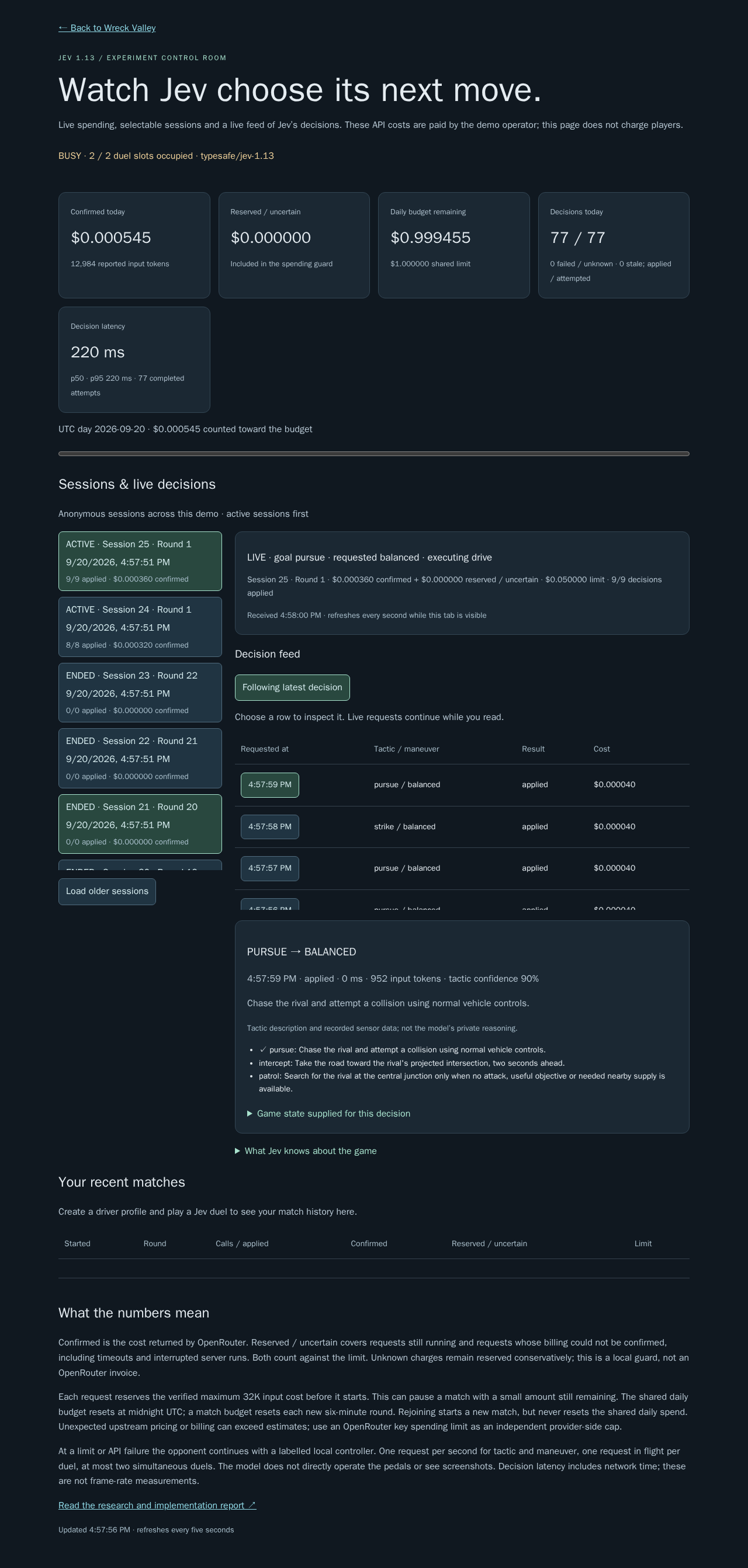
This UI recording uses a deterministic model stub with real sockets, server and ledger. It demonstrates two active duels, session selection, an inspection that stays open during refresh, connection recovery and paginated history.
- Active sessions appear first; older sessions and decisions can be loaded in pages.
- Each session shows confirmed cost, reservations, its budget and applied/attempted calls.
- Live status distinguishes the tactical goal, requested maneuver and maneuver being executed.
- Select a decision to inspect its timestamp, latency, input tokens, confidence, cost, available tactics and recorded game state. Use Follow latest decision to resume following new choices.
- Decisions persist across restarts. Legacy calls retain existing cost/tactic information and clearly show when an observation was not recorded.
Sessions are anonymous: the public monitor does not expose player names, owner tokens, provider request IDs or API keys. Tactic descriptions explain the available actions; they are not the model’s private reasoning. Polling pauses in hidden tabs and labels disconnected data.
View the monitor screenshot
Recorded live-model duel
The production client sends automated keyboard inputs into the authoritative game. There are no car-position, health or physics overrides. This excerpt uses original timing and Chromium/SwiftShader at low quality; it is not a human playtest or a hardware FPS benchmark. Final review refined post-strike pursuit status and monitor labels after this recording.
| Model tactic | Calls in live duel |
|---|---|
| intercept | 21 |
| patrol | 3 |
| pursue | 14 |
| strike | 2 |
The model chose strike twice during this run. All 40 calls were applied with no provider errors. Confirmed cost was $0.002656. The test’s $0.004 budget correctly stopped further paid calls and switched to local fallback while reserving enough room for a possible next request.
Did the new game context help?
| Scenario | Final two tactic choices | Purpose |
|---|---|---|
| clean strike | strike / strike | strike |
| vulnerable rival | strike / strike | strike |
| critical repair | repair / repair | repair |
| low nitro | nitro / nitro | nitro |
| checkpoint | objective / objective | objective |
| search | patrol / patrol | patrol |
The initial empty-tank probes chose patrol over a nearby refill. Explicit supply distance and clearer action guidance changed both follow-up choices to nitro. Other final probes selected attack, repair, objective and search as expected. All probe iterations together cost $0.001555.
Regression checks
- 450 automated tests, lint and production build passed.
- New tests cover strike eligibility, dodging, rearm timing, actual collision damage, supply selection and request-size bounds.
- Ledger/API tests cover anonymous responses, durable observations, restart liabilities, legacy data and stable pagination.
- Browser checks cover simultaneous sessions, delayed session responses, stable inspection, disconnect recovery, archived sessions and mobile layout.