WRECK VALLEY · 0.61.1 · IMPLEMENTATION & TEST REPORT
More capable driving.
Opponents you can spot.
Jev can now request boost, drift and braking. A faster local controller checks those requests against the road, grip and stopping distance. The minimap gives opponents a clear visual identity.
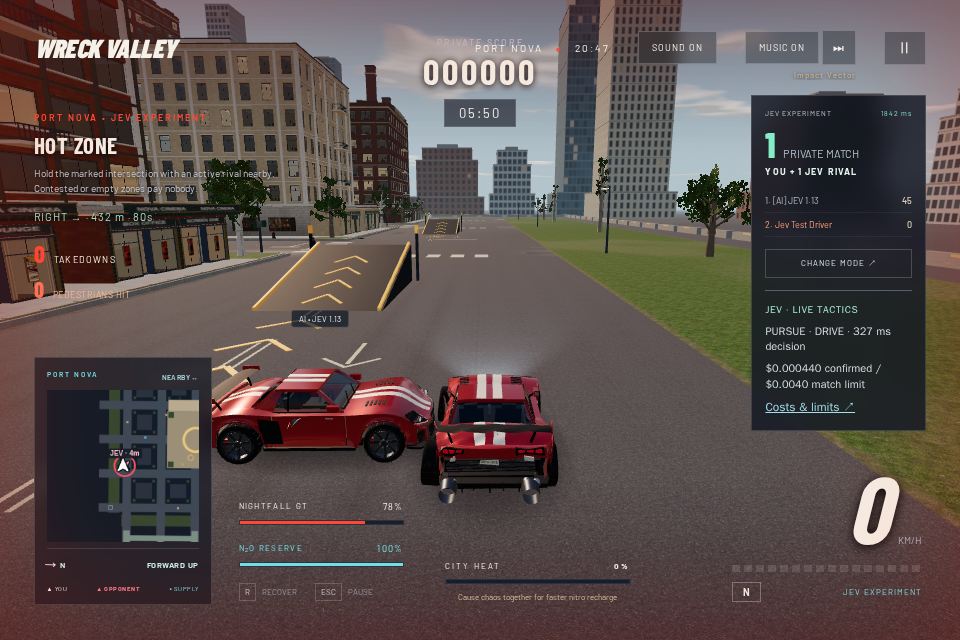
The problem was in our interface
The first integration asked Jev where to go, but its inherited road controller always disabled boost and drift. Pursuit also used the lower cruising speed, and the model had no nitro or cornering observations. This release changes the available controls and the information supplied to the model.
- Boost: close a gap on a clear, aligned straight, with enough room to brake. Save nitro around corners, on slippery surfaces, in the air or during recovery.
- Drift: prepare for an approaching bend, apply the handbrake briefly while turning, then recover grip with slip-aware steering. No sustained handbrake hold.
- Brake: slow before a junction or obstacle using the actual chassis brakes and surface grip. The local controller can override an unsafe boost immediately and does not select reverse at rest.
- Better observations: nitro, grip, surface, stopping distance, clear road, slip, target speed and upcoming turn. Healthy cars no longer waste decisions on repair trips.
The existing once-per-second request now returns both a tactic and a driving maneuver. Physics still executes at simulation speed. The HUD reports the action actually being executed; a stale model request cannot bypass current road checks.
Recorded verification
This excerpt shows the updated driving and map. Final review subsequently tightened drift cooldown and ramp guards; regression tests cover those changes. Actual keyboard inputs pass through the production client and authoritative simulation. There are no position, health or clock overrides. The isolated test uses a $0.004 match limit to check automatic fallback.
Earlier recording with boost and drift activity
This earlier driving recording predates the map refresh and the healthy-car repair filter. It uses the same maneuver controller. The input counters below include all three runs.
| Run | Applied / attempted | Boost steps | Drift steps | Brake steps | Confirmed cost |
|---|---|---|---|---|---|
| Driving iteration 1 | 65 / 65 | 21 | 27 | 746 | $0.002693 |
| Driving iteration 2 | 66 / 66 | 0 | 18 | 480 | $0.002660 |
| Map-update run | 67 / 67 | 6 | 25 | 446 | $0.002664 |
A step is 1/60 second of authoritative simulation. Braking counts include local safety braking and the fallback period; boost and drift require an active model request. The recordings use Chromium/SwiftShader at low quality, so rendering cadence is not a hardware FPS result. These are automated browser runs, not human playtests.
Did the controller improve?
| Six-second straight pursuit fixture | Closest gap | Nitro time |
|---|---|---|
| Original Jev controller | 60.0 m | 0.00 s |
| New controller, balanced | 31.2 m | 0.00 s |
| New controller, boost request | 0.4 m | 1.25 s |
Identical initial conditions: an 80 m gap, a target moving at 20 m/s and the same vehicle physics. Maneuver requests are fixed for this isolated controller comparison, with no vehicle collision response. The improved controller can close a gap that the old speed limit could not; this is not a model win-rate benchmark.
In the controlled turn fixture, a short drift completed the turn in 1.60 s versus 1.67 s with balanced driving, with less lateral overshoot at the sampled exit. The maneuver tests also verify an on-road junction traversal and a stop before a wall.
A map with clear priorities
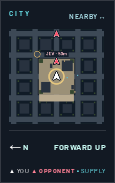
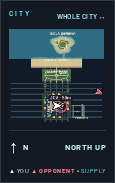
Civilian cars previously looked like rivals because both used vehicle-colored dots. Opponents now use prominent red directional arrows regardless of paint, with a label and distance for the nearest rival. Distant opponents get edge indicators; a close-contact ring prevents them disappearing under your white arrow. Traffic, loading and wrecked markers are excluded.
The nearby view centers on your car. Supplies and garages are smaller and quieter. The range button switches to a whole-city overview with the coast and island. North-up and forward-up modes remain available; touch controls and saved preferences are covered by browser tests. The map images above use a deterministic rendering fixture.
Model probes and spending
Eight controlled-speed probes matched the requested test situation: boost on a clear straight, drift at a suitable entry speed, brake before a fast bend and balanced driving on low grip. An earlier overspeed drift scenario chose braking first, which is appropriate: the planner was reporting that speed needed to come down. This is a small integration check, not a held-out gameplay benchmark.
Confirmed browser-test cost: $0.008017. All maneuver probes, including the initial overspeed cases: $0.000521. Two typed questions use more input tokens per request, but still share the existing $0.05 match and $1 UTC-day production limits. Timeouts, stale decisions, reservations and local-fallback labels retain their existing safeguards.
Regression checks
- 442 automated tests passed, including ten new driving tests, healthy-car repair filtering and four map tests.
- Production build and lint passed.
- Three live-model browser runs recorded, including actual boost, drift and braking inputs, cost cutoff and no JavaScript errors.
- Canvas pixel checks cover opponent colors, traffic filtering, edge indicators, both orientations and the city overview.
- The production navigation browser test covers map behavior, population updates, notifications, touch HUD and disconnect handling.